Zone Plates and Gratings
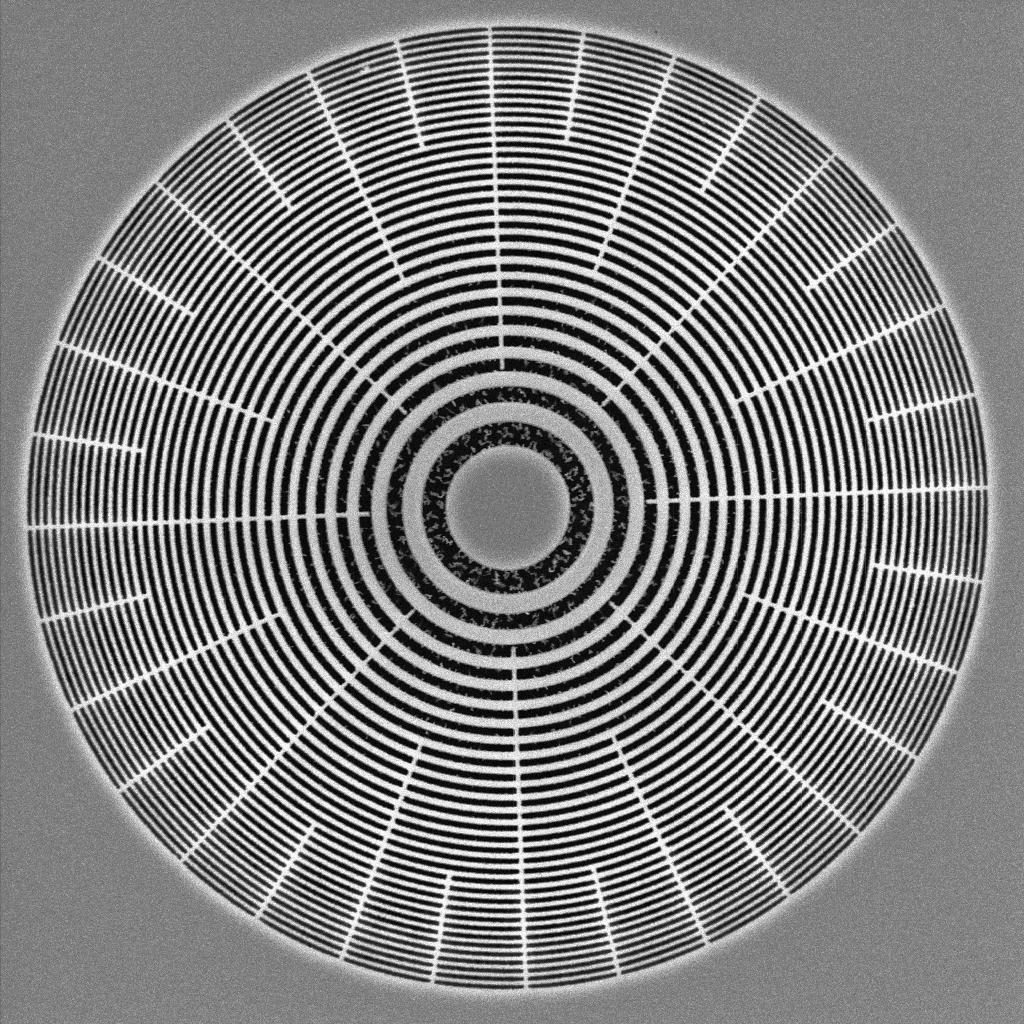
Fresnel zone plates are circular diffraction gratings used as focusing and imaging optics in soft and hard X-ray microscopy. They consist of concentric rings, known as zones, whose width decreases radially so that the diffracted X-rays converge to a focal spot. Resolution is determined by the outermost zone width (Δrn), with a diffraction-limited focal spot of approximately 1.22 Δrn, and focal length f = DΔrn/(nλ).
Only a fraction of the incident beam is diffracted into the first-order focus, the remainder is transmitted as a zero-order beam or into other diffraction orders. A “central stop” at the ZP centre is used to block the zero-order beam, so that only first-order focused radiation reaches the sample.
Tungsten zone plates
Tungsten zone plates are fabricated on silicon nitride membranes, with zone thicknesses ranging from a few hundred nanometres for soft X-rays up to 3 µm for hard X-rays. Because tungsten and silicon nitride have closely matched thermal expansion coefficients, these zone plates are significantly more stable under heating when compared to gold or nickel variants.
All silicon nitride zone plates
A new range of zone plates were developed by etching into low-stress, silicon-rich silicon nitride, providing a completely monolithic optic. This makes them an alternative to tungsten for applications where thermal robustness is critical, such as imaging heated samples at short working distances. They also offer higher diffraction efficiency than conventional zone materials at soft X-ray energies, including the water window, with outermost zones down to 30 nm. Where the film stress is close to zero, the zones can be etched through the entire membrane to give a free-standing optic held together by a fine support structure. Below ~280 eV, where silicon nitride absorbs strongly, these free-standing optics offer up to around twice the theoretical diffraction efficiency of membrane-supported zone plates.
Central stops
Gold central stops up to 4 µm thick can be electroplated directly onto the zone plate for operation up to ~5 keV. A 2 µm stop has a measured transmission of ~1×10⁻⁵ at 2.7 keV. For higher energies, a thicker absorber is required which cannot be supported by the thin membrane. In this case, separate platinum or stainless steel foil central stops are available. These are aligned and locked to the zone plate using a dedicated holder.
Off-axis (partial) zone plates are also available. With the focus located outside the fabricated area, the zero-order beam is separated without the need for a central stop.
Diffraction gratings
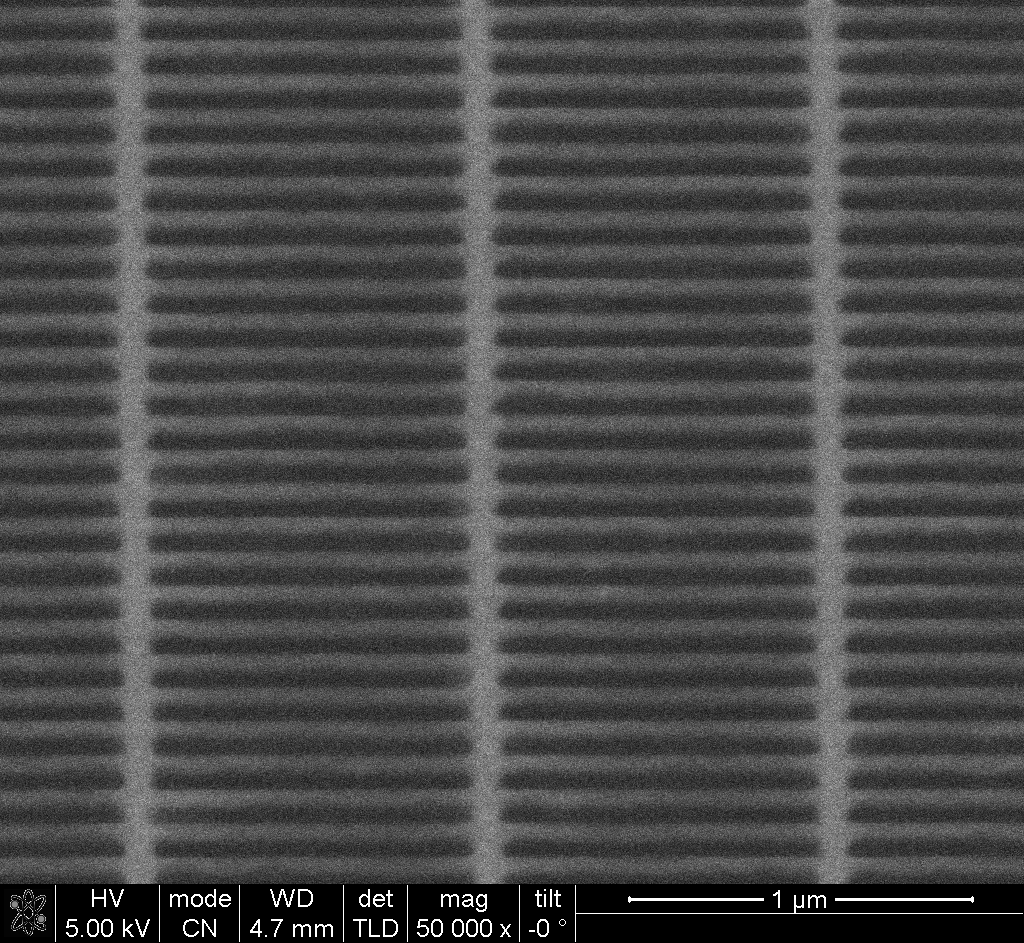
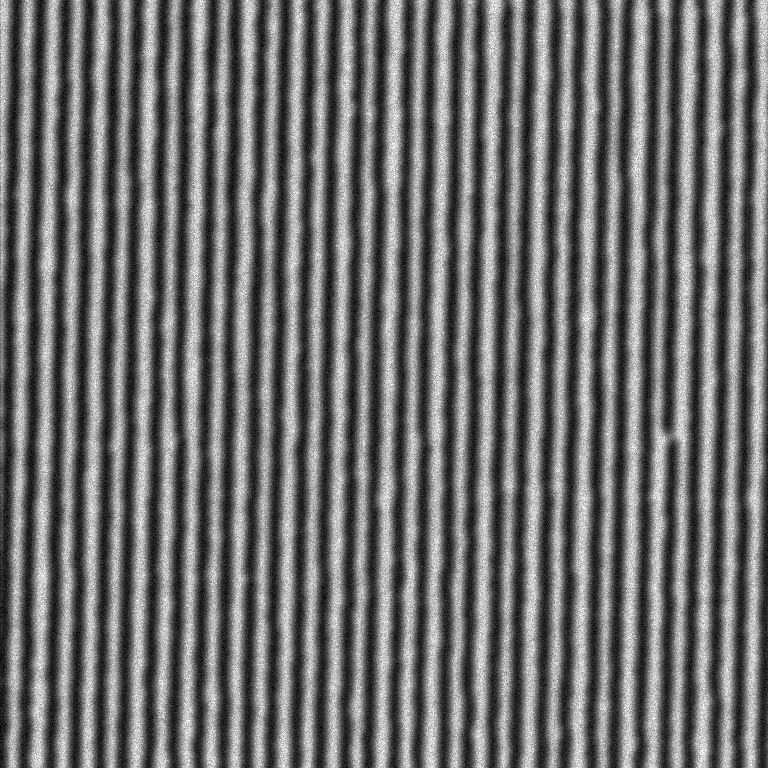
Diffraction gratings up to 20 mm² can be fabricated in a range of materials, either free-standing or on silicon nitride membranes as thin as 50 nm to minimise absorption.
Free-standing grating lines are held by a web of support struts, which typically occupies 20–40% of the area, leaving 60–80% as active grating. The period of the support structure can be chosen to give useful diffraction of its own, complementing that of the primary grating.
Free-standing grating lines normally consist of a silicon-rich nitride core coated with gold, although other metals can be used. Gratings can also be made entirely in silicon nitride, using the same thick, low-stress films as the monolithic zone plates, which give good diffraction efficiency at soft X-ray energies without a metal coating.
Grating condensers
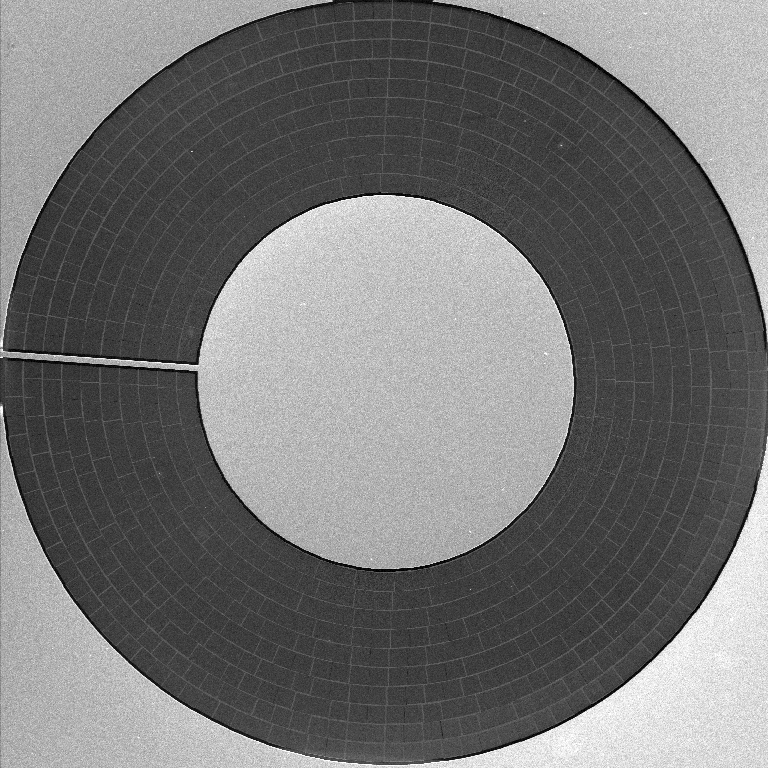
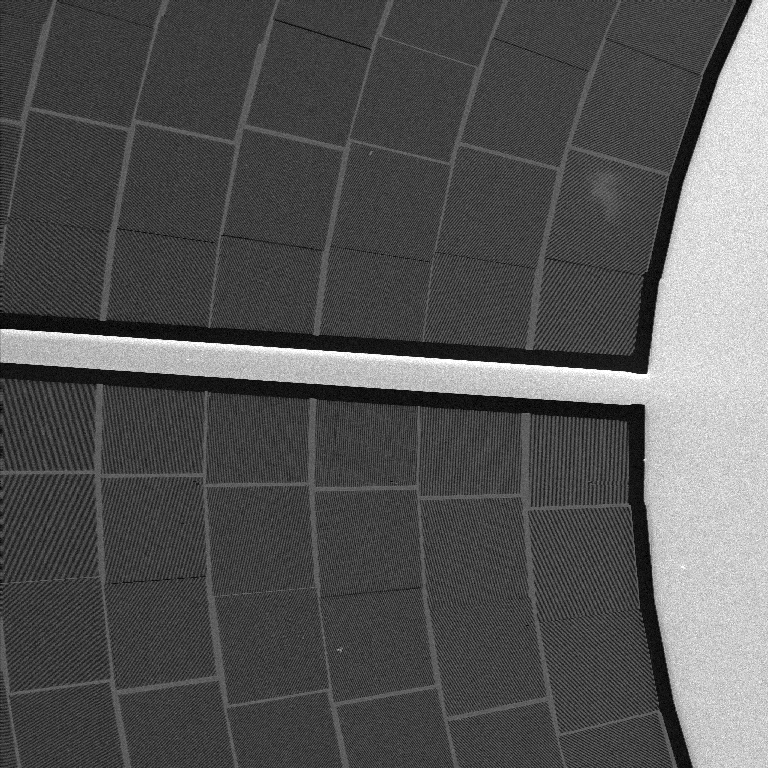
Grating condensers are an alternative to traditional zone plate condensers, made up of rings of small square gratings. Rather than focusing to a spot, the light from all the gratings overlaps at the sample to give a flat, evenly illuminated field roughly the size of a single grating, while also reducing unwanted diffraction effects from highly coherent undulator beams. Typical designs are 1 mm in diameter, with around 1000 gratings and an integrated gold central stop.
Phase plates and other custom diffractive optics are also available on request. For resolution targets and test objects, see Calibration Charts and Test Targets.
Ordering
A wide variety of zone plates and gratings with different resolutions and absorber thicknesses are available from stock and can also be made to order – contact us for more information.